
How to Choose Refraction-Room Furniture
Five decisions settle most refraction-room specifications. Each one below is answered with the figures the manufacturers publish for all 22 models.
This page compares published catalogue figures only. It is not clinical, architectural or compliance advice, and it does not promise a minimum room size or universal instrument compatibility. Standard and optional items, plug type and voltage version are confirmed against the quotation.
Five decisions, in order.
Work through these in sequence. The first decides which of the three product lines you are shopping in; the rest narrow it to a model.
1. One combined unit, or a chair and a table chosen separately?
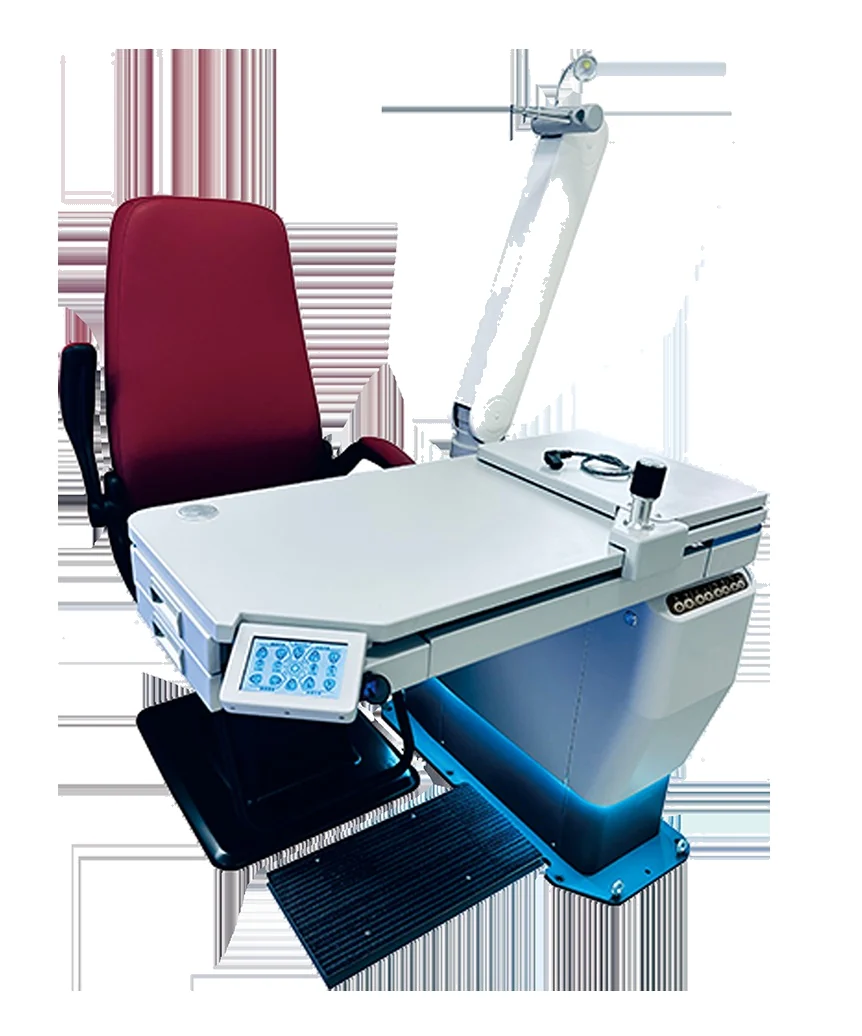
A refraction unit brings the chair, the phoropter arm and the instrument tabletop into a single assembly, so the refraction sequence runs without moving the patient between stations; North American catalogues often list the same assembly as an ophthalmic chair and stand. There are nine. The alternative is to choose an instrument table and an examination chair independently — six tables, seven chairs and stools — which gives more freedom in how the room is laid out and lets one part be changed later without the other.
2. How much floor area is there?
Among the refraction units the published figures run from 940 × 800 mm for C-3, the most compact cabinet unit, to 2100 × 1200 mm for C-800 with its side cabinet. HRT-3 publishes a 1500 × 2500 mm working footprint because its tabletop slides. Among the chairs, CH-AST is the smallest patient chair at 650 × 550 mm, while CH-3 measures 1640 × 590 mm because it travels 150 mm front to rear.
One caution when comparing: the catalogues do not all publish the same field. Some give the unit’s own dimensions, others give a space figure meaning the area to allow around it. Read those as two different measurements rather than one list, and send a room drawing before ordering.
3. How many instruments, and how much tabletop do they need?
Instrument-table tops in the range run from 400 × 480 mm on LY-3AD to 1250 × 670 mm on OT-3. Where two instruments need separate positions, OT-4 provides twin 550 × 500 mm surfaces instead of one large one, and LY-3S-1 pairs a 600 × 1080 mm top with an adjustable equipment shelf. Catalogue load ratings run from 60 kg to 200 kg and four of the six tables publish one, LY-3AH being the highest at 200 kg.
4. Which movements are powered, and how far do they travel?
Among the refraction units the published tabletop lift travel is 270 mm on TG-1010, 200 mm on MI-180, 120 mm on MI-5500A and 100 mm on HRT-3. The instrument tables publish height ranges instead: 630–800 mm on LY-3AD, 630–820 mm on LY-3AH, 660–860 mm on WB-31L10 and 680–880 mm on LY-3S-1.
For seating, published seat heights span 450–680 mm across the line, from 450–550 mm on the CH-1 practitioner stool up to 680 mm on CH-10A and CH-8. Read the travel figures carefully: CH-3 publishes 150 mm of front-to-rear travel, while MC-N and PK-310A publish 150 mm of powered lift travel. Those are not the same movement.
5. What supply voltage, and which plug?
All nine refraction units list 220 V / 50 Hz. Among the instrument tables, OT-3 and OT-4 list 220 V / 50 Hz, and WB-31L10 is the only model in the whole range that also lists 110 V / 60 Hz — the one to start from for a North American supply. The three LY tables publish no supply figure, and PK-310A lists a 24 V DC drive. Where the catalogue is silent, the voltage version and plug type are set on the quotation, so tell us the destination country.
Where to look first.
A shortcut through the five questions above. The models named are representative starting points, not the only options — each category page carries the full list with catalogue figures side by side.
| If this is your situation | Look at | Representative models |
|---|---|---|
| Small room, one refraction lane | The most compact refraction units | C-3, MI-180 |
| Two instruments on the same lane | Units with two instrument positions | HRT-1A, HRT-3 |
| Storage matters in the room | Units with drawers or a side cabinet | TG-1010, C-800 |
| Stored height positions for several operators | Touch-control unit | C-10A |
| Chair and table specified separately | An instrument table plus an examination chair | OT-3, CH-10A |
| Two instruments at different heights | Twin-top instrument table | OT-4 |
| Heavy instrument on the table | Tables with a published load rating | LY-3AH (200 kg), LY-3S-1 (120 kg) |
| 110 V / 60 Hz supply | The one dual-voltage model | WB-31L10 |
| Smallest chair footprint | Compact patient chair | CH-AST |
| Patient moved to the instrument | Chair with front-to-rear travel | CH-3 |
| Seating for the practitioner | Optometrist stool | CH-1 |
Scroll the table sideways to see every column.
What the catalogue does not settle.
Standard and optional items, plug type and voltage version are confirmed against the quotation.
Diagnostic instruments shown in product photography illustrate use and are not part of the furniture supply scope unless a quotation states otherwise.
Standard warranty is 12 months from delivery. Within that period ENOCH supplies the replacement parts needed for any fault not caused by misuse or accidental damage.
Every dimension, travel figure, load rating and colour on this site is reproduced as published by the manufacturer. Where a catalogue does not publish a figure, the field is left empty rather than estimated.
Questions we get before the first order.
Is a combined unit or a separate chair and table the better buy?
Neither is universally cheaper — it depends on the room. A combined unit puts the chair, the arm and the tabletop in one assembly, so the patient stays in place through the refraction sequence. Choosing separately lets you match the tabletop to the instruments you already own, place the chair where the room allows, and change one part later without the other. If floor area is tight and the room runs a single refraction lane, start with the units; if the room is irregular or the instrument set unusual, start with the tables and chairs.
What should I measure before ordering?
Three things settle most specifications: the clear floor area for the unit or chair, including the room a sliding tabletop or a travelling chair needs; the working height your operators want, against the published height ranges; and the footprint and weight of every instrument that has to sit on the tabletop. Send a room drawing with those and we will check them against the catalogue figures before quoting.
Are the instruments included?
No. Every figure on this site describes furniture. Diagnostic instruments shown in product photography illustrate use and are not part of the supply scope unless a quotation states otherwise.
Can I get a 110 V version?
WB-31L10 is the only model in the range whose catalogue lists both 220 V / 50 Hz and 110 V / 60 Hz. All nine refraction units list 220 V / 50 Hz. For any other model, tell us the destination country; the voltage version and plug type are then confirmed on the quotation rather than assumed here.
How many models should I shortlist?
Two or three within one line is usually enough. The models in each line differ mainly in published dimensions, in how much of the movement is powered, and in storage — so once the floor area and the instrument list are fixed, most of the range rules itself out. The comparison table on each category page is laid out for exactly that.
Tell us the room and the instruments.
Send your dimensions, quantity and destination. You will get a written configuration, lead time and quotation — usually within one business day.